
Table of Contents
- What Are Acne Scars and How Do They Form?
- Types of Acne Scars and How to Identify Yours
- Acne Scars vs. Post-Inflammatory Hyperpigmentation
- Professional Acne Scar Removal Procedures
- Post-Inflammatory Hyperpigmentation Treatment Options
- How to Prevent Acne Scarring Before It Starts
- At-Home Skincare for Scar Management and Prevention
- Frequently Asked Questions
Last Updated: October 2, 2026
What Are Acne Scars and How Do They Form?
Acne scarring happens when severe breakouts damage the deeper layers of your skin. When acne lesions penetrate deeply into the dermis, they trigger inflammation that breaks down collagen and skin cells. As your skin heals, it doesn’t always rebuild that lost tissue perfectly. The result is a visible depression, raised bump, or discolored mark where the acne once was. (Source: the National Institutes of Health (NIH))
The deeper and more inflamed your acne, the higher your risk of scarring. Cystic and nodular acne damage skin layers that take months to heal, and picking or squeezing accelerates scar formation.
Early professional treatment of deep, painful breakouts prevents acne from reaching the severity that causes permanent scarring.
Key factors in scar formation:
- Severe inflammation from cystic or nodular acne
- Delayed or improper treatment of active breakouts
- Picking, squeezing, or scratching acne lesions
- Genetics that affect how your skin heals
- Prolonged breakouts without professional care
Types of Acne Scars and How to Identify Yours
Identifying your scar type is essential for choosing the right treatment, as different scars respond to different approaches.
Atrophic Scars (Depressed Scars)
Atrophic scars are indented or pitted marks where skin sinks below the surface. These form when acne destroys collagen and your body doesn’t fully rebuild it during healing. They’re the most common type of acne scarring.
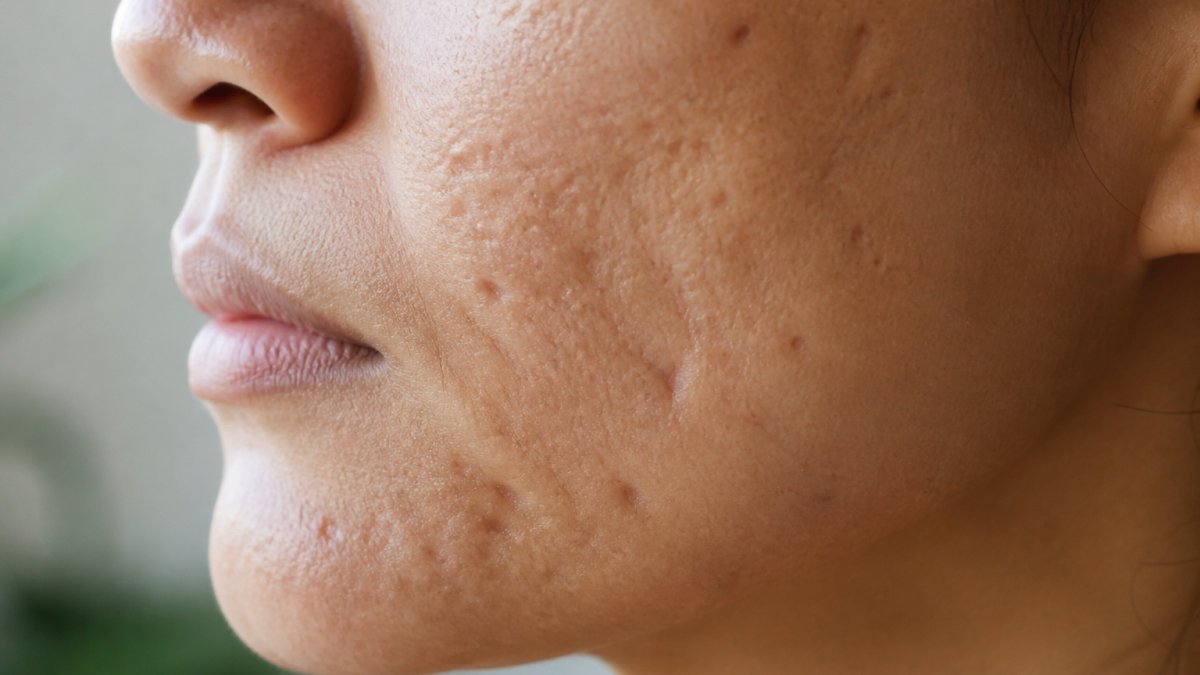
Three subtypes of atrophic scars:
Ice pick scars are narrow, deep holes that are small but highly noticeable and the hardest atrophic scars to treat.
Boxcar scars have wider, flat bottoms with sharp edges and respond well to treatment because of their defined shape.
Rolling scars have sloped, rounded edges creating a wavy texture and often affect larger areas than ice pick scars.
Hypertrophic and Keloid Scars (Raised Scars)
Hypertrophic scars are raised, thick marks where excess collagen builds up above the skin surface during healing.
Keloid scars extend beyond the original acne area and continue growing; they’re more common in people with darker skin tones and run in families.
How to tell them apart:
- Hypertrophic scars stay within the original acne boundary
- Keloid scars grow beyond the original area
- Both feel thick and raised when you touch them
- Both are more common on the chest and back than the face
Acne Scars vs. Post-Inflammatory Hyperpigmentation
Many people confuse acne scarring with post-inflammatory hyperpigmentation, but they’re completely different. Understanding the difference changes which treatments will actually help you.
Post-inflammatory hyperpigmentation is flat discoloration from excess melanin production after acne heals. These marks fade on their own over months or years.
Acne scarring involves actual texture changes and permanent damage to skin structure. The skin is either depressed (sunken) or raised (bumpy). These won’t fade without treatment.
Here’s the practical difference: if you can’t feel the mark when you run your finger across your skin, it’s probably hyperpigmentation. If you can feel an indent or bump, it’s scarring.
Why this matters for treatment:
- Hyperpigmentation responds to brightening ingredients and sun protection
- Acne scarring requires procedures that rebuild or reshape skin
- Treating hyperpigmentation won’t help scars, and vice versa
- You might have both at the same time in different areas
Professional Acne Scar Removal Procedures
Professional treatments stimulate collagen, resurface skin, or break up scar tissue. Different procedures suit different scar types and recovery timelines.
Microneedling and Skin Resurfacing
Microneedling creates controlled micro-injuries that trigger collagen production, filling depressed scars and improving texture over multiple sessions.
Microneedling works best for atrophic scars and requires 3-6 sessions spaced 4-6 weeks apart, with results continuing to develop for 6-12 months.
Realistic recovery timeline for microneedling:
- Day 0-1: Immediate redness, mild swelling, and a sandpaper-like texture. Avoid makeup, heavy exercise, and hot water.
- Day 2-3: Redness fades to pink; light flaking begins. You can return to light activities and use gentle skincare.
- Day 4-7: Most visible redness resolves; mild peeling continues. Makeup is safe to wear; sun protection becomes critical.
- Week 2+: Skin returns to normal appearance, though collagen rebuilding continues invisibly for weeks.
Most people return to work the next day with makeup coverage, but avoid direct sun, intense exercise, and acne treatments for 48 hours.
Laser Therapy and Chemical Peels
Laser treatments remove damaged skin layers and heat deeper layers to stimulate collagen. Fractional lasers are gentler and cause less downtime than full-field lasers.
Book Skincare Services in Townsquare →
Chemical peels use acids to dissolve top skin layers and prompt new growth. Stronger peels penetrate deeper but require more recovery; they work well for mild to moderate scarring and hyperpigmentation.
Recovery varies significantly by intensity:
Light peels (glycolic acid, 20-30%): Minimal downtime; skin returns to normal within hours. Safe for all skin types; repeat every 2-4 weeks. Noticeable improvement after 6-8 treatments.
Medium peels (trichloroacetic acid, 35-50%): Redness, swelling, and peeling for 5-7 days. More dramatic results than light peels; 1-3 treatments spaced 4-6 weeks apart. Not recommended for darker skin tones.
Strong peels (phenol or high-concentration TCA, 50%+): Significant peeling for 1-2 weeks with higher complication risk. Typically one-time treatment for severe scarring; higher risk for darker skin tones.
Fractional laser treatments fall between light and medium peels in terms of recovery. Most people experience redness for 3-5 days and can return to work with makeup coverage by day 2-3.
Subcision and Dermabrasion
Subcision breaks up fibrous bands tethering depressed scars, allowing skin to rise. It works especially well for rolling and boxcar scars.
Subcision recovery: Bruising and swelling for 5-10 days; redness for 2-3 weeks. Results improve over 2-3 months; often combined with microneedling for better results.
Dermabrasion sands down top skin layers and works best for shallow scars.
Choosing a Procedure: Practical Considerations
Consider scar type, schedule, skin tone, and severity when choosing treatment. Microneedling offers shortest downtime for all skin types. Laser and peels offer faster results but need more recovery. Darker skin tones should prioritize microneedling, fractional laser, or light peels.
Post-Inflammatory Hyperpigmentation Treatment Options
Topical brightening ingredients like Vitamin C, niacinamide, kojic acid, and azelaic acid reduce melanin and fade pigment. Use consistently for 8-12 weeks for noticeable results.
How to Prevent Acne Scarring Before It Starts
The best treatment for acne scarring is prevention. Once scars form, they’re permanent without professional intervention.
At-Home Skincare for Scar Management and Prevention
Professional treatments work best with a solid home routine using the right ingredients in the right order and avoiding irritating combinations.
Core Ingredients for Scar and Hyperpigmentation Management
Retinoids boost collagen production and improve texture. Start with retinol at 0.25-0.5%, increasing to 1% after 4-6 weeks. Prescription retinoids work faster but require oversight. Consistent use for 3-6 months shows improvement in mild scarring; results peak at 6-12 months.
Critical Ingredient Interactions: What NOT to Mix
Combining certain actives can cause irritation, reduce efficacy, or damage your skin barrier, a mistake that sets back scar improvement by weeks.
Realistic Timelines for At-Home Results
Understanding when to expect improvement prevents frustration and helps you decide if professional treatment is necessary.
Mild scarring (shallow rolling or boxcar scars, slight texture irregularities):
- Retinoids: 3-6 months for noticeable improvement; 12 months for significant results
- Vitamin C + sunscreen: 4-8 weeks for brightness; 3-6 months for texture
- Azelaic acid: 8-12 weeks for hyperpigmentation; 4-6 months for mild texture improvement
- Realistic expectation: 30-50% improvement with consistent use over one year
Moderate scarring (deeper boxcar or rolling scars, visible indentations):
- At-home ingredients alone rarely produce dramatic results
- Retinoids may improve texture slightly (10-20% improvement) but won’t fill deep indentations
- Combination with professional treatment (microneedling or laser) is necessary for meaningful change
- Realistic expectation: at-home care prevents worsening and supports professional treatment results
Post-inflammatory hyperpigmentation (flat discoloration, no texture change):
- Vitamin C + sunscreen: 8-12 weeks for noticeable fading
- Azelaic acid: 8-12 weeks for significant improvement, especially on darker skin tones
- Niacinamide: 4-8 weeks for subtle brightening
- Realistic expectation: 40-70% fading over 6 months with consistent use; complete fading may take 12-24 months
Building Your At-Home Routine
Start simple. If you’re new to actives, begin with sunscreen + one active ingredient (retinoid or azelaic acid) for 4-6 weeks before adding a second. This prevents irritation and helps you identify which ingredient works best for your skin.
Frequently Asked Questions
Can a scar from a pimple go away on its own?
Some post-acne marks fade naturally over time as skin heals, especially post-inflammatory hyperpigmentation, which typically improves within 3-12 months. True acne scars—those involving collagen loss and dermis damage—do not disappear completely without treatment. Early intervention and proper skincare can minimize their appearance and prevent new scarring. A dermatologist can assess whether marks will fade naturally or require professional treatment.
What kind of pimples cause scars?
Severe inflammatory acne lesions cause scarring: deep cystic pimples, nodules, and pustules that penetrate into the dermis layer. Picking, squeezing, or popping pimples increases scarring risk by damaging surrounding skin tissue. Hormonal breakouts and acne left untreated for extended periods are more likely to scar. Milder whiteheads and surface-level pimples rarely scar unless manipulated or infected.
How can I differentiate between post-acne marks and true acne scars?
Post-inflammatory hyperpigmentation appears as flat, discolored patches and fades naturally over months. True acne scars involve texture changes: indented pits (atrophic scars), raised bumps (hypertrophic or keloid scars), or visible scar tissue. Run your finger across the area—if you feel a depression or raised tissue, it’s a true scar. A dermatological assessment can confirm which type you have and recommend the appropriate treatment path.
Does popping a pimple increase the likelihood of developing a scar?
Yes. Squeezing or picking pimples damages the skin barrier and surrounding dermis, pushing bacteria deeper and causing inflammation. This increases both scarring risk and the severity of scars that form. Picking also introduces bacteria that can worsen breakouts. Leaving pimples alone and treating them with appropriate topical treatments or professional extraction by a licensed aesthetician or dermatologist minimizes scarring potential.
Acne scarring feels permanent because it is, without treatment. But you have real options. The approach that works depends on your scar type, skin tone, budget, and how much downtime you can handle. At Acne Clinic By Justina, we create personalized treatment plans that address your specific concerns. Our team combines professional procedures with medical-grade skincare to deliver lasting results. Book a consultation to see which treatments suit your skin and scars best.