
Table of Contents
- When to See a Dermatologist for Acne
- What to Expect at a Dermatologist Appointment for Acne
- Dermatologist Acne Treatment Options Explained
- How Long Does Acne Treatment Take to Work
- Building a Skincare Routine Alongside Professional Treatment
- Preventing Acne Scarring and Long-Term Skin Health
- Frequently Asked Questions
Last Updated: October 4, 2026
When to See a Dermatologist for Acne
You don’t need a dermatologist for occasional breakouts. But if acne persists beyond a few weeks, covers large areas, causes pain, or leaves scars, book an appointment. A dermatologist acne specialist can diagnose the root cause and create a tailored treatment plan.
Many people delay seeing a dermatologist, trying over-the-counter products for months. By then, acne may have caused permanent scarring or spread to the chest and back. Early professional help prevents lasting damage.
We recommend seeing a dermatologist if:
- Acne doesn’t improve after 6-8 weeks of consistent over-the-counter treatment
- Breakouts are painful, cystic, or deep under the skin
- Acne appears on your neck, chest, shoulders, or back
- You’re experiencing significant scarring or dark spots
- Acne is affecting your confidence or mental health
- You’re a teenager or young adult with persistent breakouts
- You have hormonal acne or suspect hormonal triggers
Professional treatment works faster and prevents complications. A dermatologist can identify whether your acne is bacterial, hormonal, or inflammatory, a diagnosis that changes your entire treatment approach.
What to Expect at a Dermatologist Appointment for Acne
Your first appointment includes a skin exam, questions about your history, and treatment options discussion. Understanding what to expect helps you prepare.
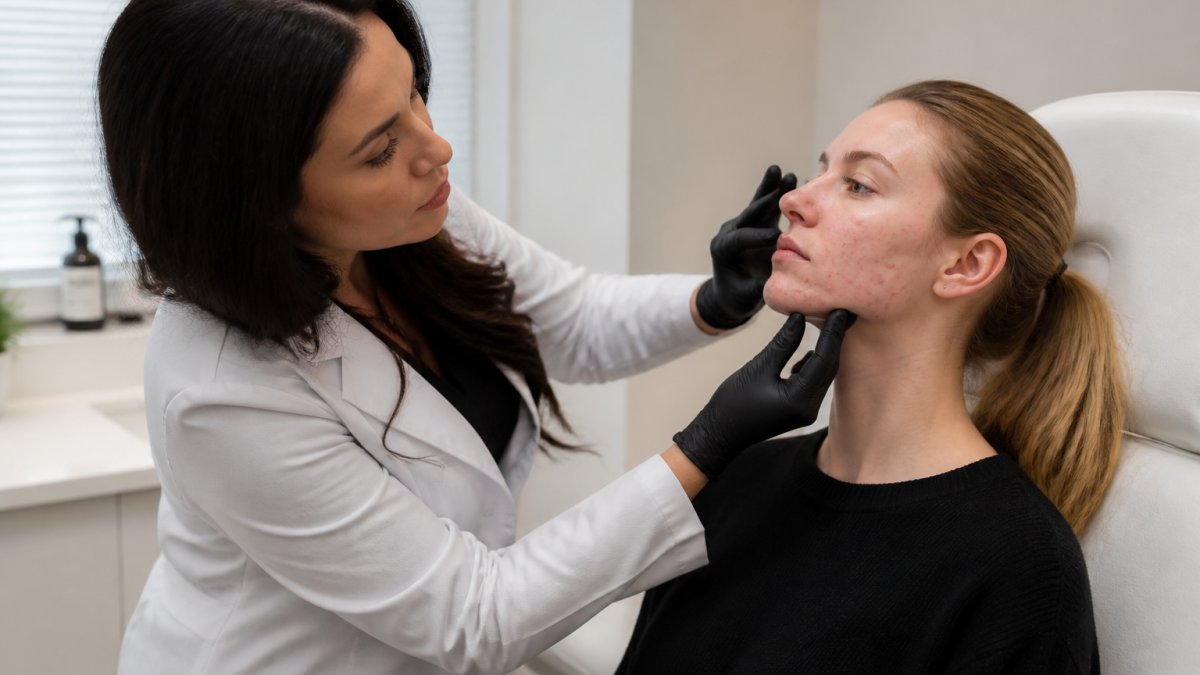
How dermatologists assess acne severity and type
The dermatologist examines where acne appears, identifies lesion types (blackheads, whiteheads, pustules, cysts), and assesses inflammation. This brief visual assessment reveals significant information.
They may ask you to describe your acne:
- When did it start?
- Does it get worse at certain times (before your period, during stress, in summer)?
- Which products have you tried?
- Does your family have a history of acne?
- Are you taking any medications?
Acne severity ranges from mild (scattered breakouts) to moderate (larger areas, deeper bumps) to severe (painful cysts, widespread inflammation, scarring risk). Classification guides treatment decisions.
They also assess your skin type (oily, dry, combination, sensitive) because treatments work differently on each. A treatment perfect for oily skin might irritate dry skin.
Questions your dermatologist will ask
Your dermatologist needs a complete picture. Come prepared to answer: What’s your current skincare routine? Have you tried acne medications before? Do you have allergies to medications or ingredients? Are you pregnant or planning pregnancy? Do you have other skin conditions? How is acne affecting your mental health?
These questions help your dermatologist avoid ineffective or unsafe treatments, for example, certain medications are unsafe during pregnancy. Be honest about what you’ve tried and how consistently you used it. Your dermatologist is gathering information to help you, not judging.
Dermatologist Acne Treatment Options Explained
A dermatologist about acne offers several proven approaches. The right choice depends on acne type, severity, skin sensitivity, and desired timeline. Most people need combination treatments.
Prescription topical treatments
Topical treatments go directly on your skin. Prescription options are stronger than over-the-counter versions and work faster.
Retinoids (tretinoin, adapalene, tazarotene) unclog pores, reduce inflammation, and speed cell turnover. Results take 6-12 weeks; expect initial dryness, redness, and peeling. Always use sunscreen, as retinoids increase sun sensitivity.
Benzoyl peroxide kills bacteria and reduces oil, with results in 2-3 weeks. Prescription-strength versions are more effective than drugstore options, though it can bleach fabrics and cause dryness.
Antibiotics (clindamycin, erythromycin) reduce bacteria and inflammation, working well for inflammatory acne. They’re often combined with benzoyl peroxide or retinoids for better results.
Combination products mix two or three ingredients. For example, a prescription cream might contain both adapalene and benzoyl peroxide. These combinations attack acne from multiple angles.
Oral medications and antibiotics
When acne is moderate to severe or covers large areas, topical treatments alone may not be enough. Oral medications work throughout your entire body.
Oral antibiotics (doxycycline, minocycline) reduce bacteria and inflammation for inflammatory acne. Prescribed for 3-6 months to prevent resistance, they’re typically paired with topical treatment.
Spironolactone blocks androgens and helps hormonal acne in women and teens, with results in 2-3 months. Mild side effects may include dizziness or irregular periods; regular blood work monitors potassium levels.
Isotretinoin (Accutane) is the strongest acne medication, reserved for severe, scarring acne unresponsive to other treatments (the FDA). It can permanently clear acne but carries serious risks including birth defects, depression, and liver damage. Monthly blood tests and strict monitoring are required.
Hormonal treatments for acne
Hormonal acne flares around your menstrual cycle. If your acne worsens before your period, hormonal treatment may help.
Birth control pills containing estrogen and progestin reduce acne by lowering androgen levels, with results in 2-3 months. Your dermatologist will recommend specific formulations, as not all are equally effective.
Spironolactone (mentioned above) also works for hormonal acne by blocking androgen receptors in the skin.
Hormonal treatments work best combined with topical treatments, addressing hormonal triggers while topicals handle bacteria and inflammation.
Professional procedures and light therapy
For acne that doesn’t respond to medication or to speed up healing, professional procedures offer additional options.
Chemical peels exfoliate, unclog pores, and reduce inflammation. A series of 4-6 treatments significantly improves acne and helps with scarring and dark spots.
Microneedling stimulates collagen to improve skin texture, particularly useful for acne scarring. Multiple sessions are needed.
Laser and light therapies target bacteria and inflammation. Blue light kills bacteria; red light reduces inflammation. Multiple sessions are required. (Source: the National Institutes of Health’s findings on acne treatment)
Extractions during professional facials remove stubborn blackheads and whiteheads. Never squeeze acne at home, it spreads bacteria and causes scarring. A dermatologist or licensed aesthetician can extract safely.
How Long Does Acne Treatment Take to Work
Understanding realistic timelines helps you stay committed when results don’t appear overnight. Timelines depend on treatment, skin type, and acne severity.
Realistic timelines for different treatments
Topical retinoids take 6-12 weeks to show significant improvement. Your skin may look worse in weeks 2-4 as dead skin cells shed and inflammation temporarily increases. Stick with it. By week 8-12, you’ll see clearer skin, smaller pores, and fewer new breakouts.
Benzoyl peroxide works faster, 2-4 weeks for visible improvement. It’s gentler on your skin than retinoids, so many people tolerate it better.
Oral antibiotics typically show results in 4-8 weeks. Combined with a topical treatment, results come faster.
Hormonal treatments (birth control or spironolactone) take 2-3 months to reduce acne. Hormonal acne is stubborn because it’s driven by internal factors, not just bacteria.
Chemical peels show improvement after the first treatment, but a full series (4-6 peels) spaced 2-4 weeks apart produces the best results.
Isotretinoin can clear acne permanently in 16-20 weeks, but the medication requires strict monitoring and carries real risks.
|
Treatment Type |
Time to See Results |
Full Results Timeline |
Notes |
|---|---|---|---|
|
Topical retinoids |
6-8 weeks |
12 weeks |
May worsen initially |
|
Benzoyl peroxide |
2-3 weeks |
4-6 weeks |
Faster but milder |
|
Oral antibiotics |
4-6 weeks |
8-12 weeks |
Works best with topical |
|
Hormonal treatments |
8-12 weeks |
3-4 months |
For hormonal acne only |
|
Chemical peels |
1-2 weeks |
8-12 weeks (series) |
Multiple sessions needed |
|
Isotretinoin |
8-12 weeks |
16-20 weeks |
Strongest option, most monitoring |
What happens when acne gets worse before it improves
This is the hardest part of acne treatment. Many people quit after a few weeks because their skin looks worse, not better. This temporary worsening is called a “purge” or “retinization.”
When starting acne treatment, your skin speeds up cell turnover, bringing trapped dead skin, oil, and bacteria to the surface. This temporary “purge” looks like more acne but is actually your skin clearing itself, lasting 2-4 weeks.
During a purge, your skin may feel dry, irritated, and sensitive. Help your skin by:
- Using a gentle cleanser (not harsh or stripping)
- Moisturizing twice daily
- Applying sunscreen every morning
- Avoiding other active ingredients temporarily
- Not picking or squeezing breakouts
Your dermatologist might adjust your treatment strength or frequency to ease the transition. They might recommend starting with a lower concentration of retinoid or using it every other night instead of nightly.
Building a Skincare Routine Alongside Professional Treatment
Professional treatment works best when paired with a simple, consistent skincare routine. You don’t need expensive products, you need the right ones for your skin and your treatment.
Your routine should have three steps: cleanse, treat, and protect.
Cleanse twice daily with a gentle, non-stripping cleanser. Avoid scrubs, which irritate acne-prone skin. Wash for 20-30 seconds and pat dry. Over-washing or using harsh cleansers damages your skin barrier and makes acne worse.
Treat with your prescribed medication. Use it exactly as directed. More isn’t better, overusing acne medication causes irritation and doesn’t clear acne faster.
Protect with sunscreen every morning. Acne treatments increase sun sensitivity. SPF 30 or higher, applied generously, prevents sun damage and dark spots.
Avoid these while treating acne:
- Vitamin C serums (can irritate with retinoids)
- Acids (AHAs, BHAs) if using retinoids
- Essential oils or fragrance
- Heavy, occlusive moisturizers (unless your skin is very dry)
- Benzoyl peroxide and retinoids together at first (introduce one, then the other)
Your dermatologist or a licensed aesthetician can recommend specific products that work with your treatment. We customize skincare routines to match your prescribed treatment and skin type. A routine that works for your friend might irritate your skin, personalization matters.
Preventing Acne Scarring and Long-Term Skin Health
Acne scars are permanent. Once they form, they’re difficult to treat. Prevention is far easier than correction. The best way to prevent scarring is to treat acne early and aggressively.
Scarring happens when acne causes deep inflammation that damages collagen. Cystic acne and nodular acne are most likely to scar. Picking, squeezing, or extracting acne at home dramatically increases scarring risk.
If you notice acne isn’t improving after 6-8 weeks of treatment, see a dermatologist immediately. Early intervention prevents scarring. If scarring has already occurred, treatments like laser therapy, microneedling, and chemical peels can improve appearance, but they can’t completely erase scars.
Protect your skin long-term by:
- Treating acne promptly and consistently
- Never picking or squeezing breakouts
- Wearing sunscreen daily (sun exposure darkens scars)
- Following your dermatologist’s treatment plan exactly
- Getting professional help if acne worsens or spreads
- Maintaining a consistent skincare routine even after acne clears
Many people stop treatment once their skin clears. This is a mistake. Acne often returns without ongoing maintenance. Your dermatologist will recommend a long-term plan to keep skin clear.
Acne affects your confidence and your skin. A dermatologist about acne can create a treatment plan that actually works for your specific skin. The key is starting early, being patient with timelines, and following through consistently.
Frequently Asked Questions
Is it a good idea to see a dermatologist for acne?
Yes. A dermatologist can diagnose the type and severity of your acne, identify underlying causes, and recommend prescription treatments that over-the-counter products cannot provide. This is especially important if acne persists despite consistent skincare, causes scarring, or significantly affects your confidence. Professional treatment addresses root causes rather than just surface symptoms.
When should adults see a dermatologist about acne?
See a dermatologist if acne persists for more than a few weeks, covers large areas of your face or body, causes painful cysts or nodules, leaves scars, or fails to improve with over-the-counter treatments. Adult acne often has different triggers than teen acne—hormonal changes, stress, or underlying conditions—so professional evaluation helps identify what’s actually causing your breakouts.
What should I bring up at an acne appointment?
Tell your dermatologist about your full acne history, products you’ve already tried, any skin sensitivities or allergies, medications you take, recent life changes (stress, diet, sleep), and whether acne runs in your family. If you have concerns about scarring, hyperpigmentation, or how acne affects your skin tone, mention those too. Being specific helps your dermatologist choose the most effective treatment for your situation.
How long does it take for acne treatment to work?
Most topical treatments show initial improvement in 4-8 weeks, though full results may take 8-12 weeks of consistent use. Oral medications like antibiotics typically work within 6-8 weeks. Some treatments cause acne to worsen briefly before improving—this is normal and usually resolves within 2-4 weeks. Patience and adherence to your dermatologist’s plan are key to success.